

Kitchen POTS
Navigating Disability in the Kitchen

“Maybe now you can try culinary school!”
“At this point, I’m too disabled to work in food service.”
My response was automatic, but honest. We don’t often acknowledge that cooking is a physically and mentally intensive task. But even at home, cooking requires multi-tasking, executive function, and problem-solving, while simultaneously standing, moving, and using small motor functions. For my body, that’s a challenge.
I was diagnosed with fibromyalgia in my 20s. I’m in pain every day, but the amount and the body parts affected change constantly. Sometimes my knees and hips crackle and pop as I walk. Some days holding my head upright hurts; on others I’m weightlifting. Despite having a lifelong medical condition that required lifestyle changes and constant medical care, I didn’t think of myself as disabled at this point. I could still do most things if I was willing to accept the resulting pain.
Life takes a toll, despite our culture’s constant efforts to fight against and forget it. But here’s the truth: every single person will experience a change in their abilities in their lifetime. A person in their 80s doesn’t have the same physicality that they did in their younger years. Reader, you will develop a disability in your lifetime. How much it impacts your life will vary, but it is inevitable.
In 2023, I started having new symptoms that were much less manageable. Walking three blocks could exhaust me, leaving me sweating, dizzy, nauseous. Standing too long made me faint. I was tired and no amount of sleep seemed to help. Another wave of extensive, expensive doctors’ appointments later and I was diagnosed with Postural Orthostatic Tachycardia Syndrome (POTS).
My disabilities aren’t apparent1 but that doesn’t mean they are any less present. I’ve had to make adaptations in all aspects of my life, but cooking has been one of the biggest challenges. Most appliances and kitchen layouts aren’t built with universal design principles, so disabled people are left to figure out their own accommodations. My kitchen counters are set at ‘standard height’, so I can’t sit while I do prep. While it’s a small grumble for me, wheelchair riders wouldn’t be able to cook at all. As Mark Hay notes, “systematic lack of intuitive accessibility can be daunting…and reinforce the view that kitchens just aren't a safe place for a population that, in reality, designers have simply historically failed to account for.”2 I’m sharing some adaptations that have made cooking with POTS and fibromyalgia accessible to me, but anyone can use these kitchen tips!
Check Your Fit
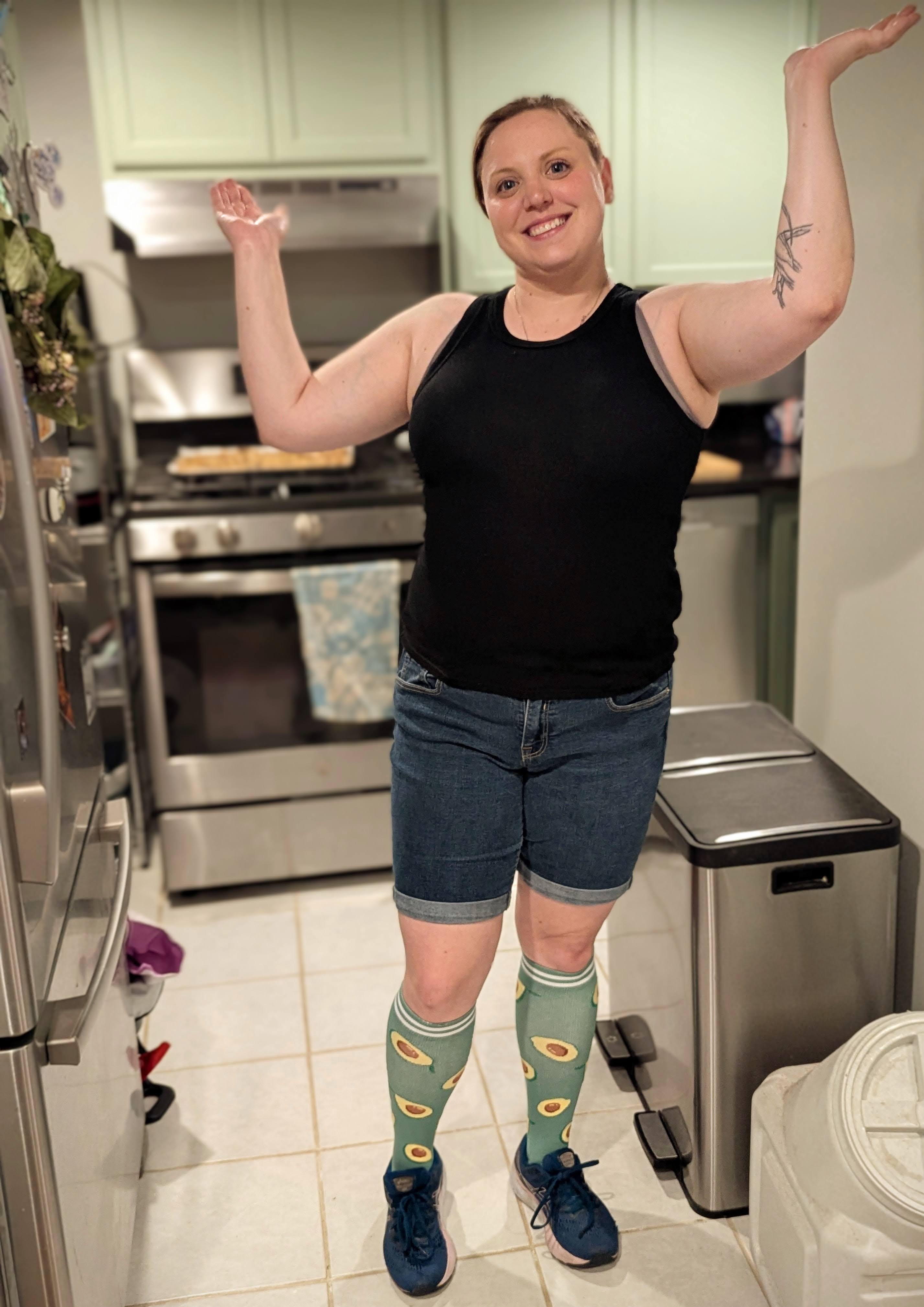
One of the first things I realized was that my outfit mattered. My kitchen is tiny and standing room only, so I need tools to help me stand for longer periods without triggering a fainting episode. Step 1: compression socks to help my circulation. Step 2: an old pair of running shoes with thick soles lend more support and cushion to minimize impact. Step 3: summer clothes all year round. Since POTS also impacts temperature regulation, the heat in the kitchen can be a trigger.
Set It and Forget It
When you have energy-limiting disabilities, you are constantly trying to calculate how much effort a task will take and how to balance your entire day. Using cooking methods that don’t need as much monitoring allows me to take a break and save up some spoons.3 That’s why I rely on my oven, pressure cooker, and slow cooker. Those recipes have built in waiting times, so I can set a timer and sit down. I’ve found that using the stovetop and grilling can make anyone’s legs and feet ache. When I use hands-off cooking methods, making a meal doesn’t cost a fibromyalgia flare up.
Get a Grip
When you hurt your hands, you realize quickly why they were an evolutionary leap. Fibro flare-ups can make me feel like I’m cooking with mittens. If your manual dexterity, stability, or grip need assistance, silicone mats4 are an affordable and effective solution.
I put mats under my cutting boards to reduce the amount of effort and maneuvering I need to do. If you don’t want to buy them, a damp paper towel under the board does the same thing.
Why the Info Dump?
I figured out these adaptations by trial and error. Researching this post was the first time I saw articles about disability accommodation in the home kitchen. Kitchen tips and tools are often marketed to abled people, even if they were designed for people with disabilities, because it’s more profitable. I hope that I can make this conversation louder so more people share their adaptations, and we can collectively increase accessibility. Disabled people deserve access to cook without obstacles.
If I’m not using a cane, there’s no externally observable marker of my condition. I prefer non-apparent over the more common phrase invisible disability, because it puts the onus on the observer. When someone decides that I “don’t look disabled”, it doesn’t change my reality, just how they treat me.
The Spoon Theory by Christine Miserandino is a helpful frame to talk about physical, emotional, and mental energy levels! I use it regularly and it makes communication much clearer.
Sold as jar opener pads, silicone gripper pads, or silicone trivets. The cheap flat ones are the best for the job.
I love this, and am so glad you found a way around the kitchen that works for you. I absolutely adore my grippy mats, too, and my slow cooker, Instant Pot, and bread machine. Oven? Only during the winter. I don't want to heat up my kitchen unnecessarily in the summer.
Very helpful article. I'm developing some of the disabilities that come with age, and cooking became difficult. I found myself having to take breaks and sit in the middle of making dinner, which I never used to have to do. The compression socks really help, and I need to use my slow cooker more.